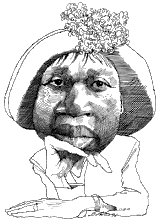
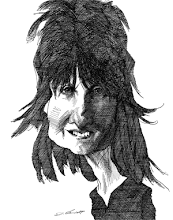
"Luckily, I am writing a memoir and not a work of fiction, and therefore I do not have to account for my grandmother's unpleasing character and look for the Oedipal fixation or the traumatic experience which would give her that clinical authenticity that is nowadays so desirable in portraiture. I do not know how my grandmother got the way she was; I assume, from family photographs and from the inflexibility of her habits, that she was always the same, and it seems as idle to inquire into her childhood as to ask what was ailing Iago or look for the error in toilet-training that was responsible for Lady Macbeth."
(Page 33)
Monday, September 29, 2008

 "Many a time, in the course of doing these memoirs, I have wished that I were writing fiction." (Mary McCarthy, 3)
Memories of a Catholic Girlhood: Losing Faith
"These priests, I thought bitterly, seemed to imagine that you could do nothing for yourself, that everything was from inheritance and reading, just as they imagined that Christ could not have been a "mere man," and just for that matter, as they kept saying that you must have "faith," a word that had become more and more irritating to me during the past few days..."
(Page 123)
I think that many people go through a time in their life when the word "faith" means less to them than a stranger passing by on the street. Mary is clearly becoming irritated with the idea of faith because the Church and Catholic doctrine has defined what faith should be. She doesn't want to be told how to think, and that is clear in many other instances in the memoir. Her distaste of the word "faith" reminds me of a time when a friend of mine told me that she is "half-Jewish and half-Catholic." To me this seemed strange, and for some reason it has irritated me until this day. I told her that a person's religion cannot be mixed like nationalities can be. You can't be half-Jewish and half-Catholic, because you would be a complete hypocrite. You can't believe that Jesus is the Messiah one day and completely throw that belief out the window the next day. She did not understand me and just shook off what I had said, reminding me that she received double the presents during the holiday season. And then people wonder why religion is so often associated with hypocrisy!
Have you ever experienced a loss of faith? Did you regain this faith in something or someone, or did you lose it forever?
~Megan
(Page 123)
I think that many people go through a time in their life when the word "faith" means less to them than a stranger passing by on the street. Mary is clearly becoming irritated with the idea of faith because the Church and Catholic doctrine has defined what faith should be. She doesn't want to be told how to think, and that is clear in many other instances in the memoir. Her distaste of the word "faith" reminds me of a time when a friend of mine told me that she is "half-Jewish and half-Catholic." To me this seemed strange, and for some reason it has irritated me until this day. I told her that a person's religion cannot be mixed like nationalities can be. You can't be half-Jewish and half-Catholic, because you would be a complete hypocrite. You can't believe that Jesus is the Messiah one day and completely throw that belief out the window the next day. She did not understand me and just shook off what I had said, reminding me that she received double the presents during the holiday season. And then people wonder why religion is so often associated with hypocrisy!
Have you ever experienced a loss of faith? Did you regain this faith in something or someone, or did you lose it forever?
~Megan
Chiasmus
Sorry for the delay of my post, but I want to share a quote I found that to me is an example of chiasmus:
"[Captain Auld] was a slaveholder without the ability to hold slaves." In my copy it's on page 50, but it can be found in Chapter 9.
This quote stuck out to me as I was reading it because it just seemed so odd at first. It's hard for me to think, with all that I have learned about slavery, that there was a slaveholder who was not "born" for the part. I think that the idea of having someone who owned slaves but had really no idea how to do so is absurd to me. After seeing this quote, I thought more about it and realized that it wasn't such an odd idea after all. No one is born into being a certain way, but it is a matter of developing into such behaviors. Unless someone is born into wealth, they don't always hold the personality of someone who is rich when money comes into possession. It's like Douglass explains, Captain Auld was not born into a family that had slaves. This way, it's easier to understand how he did not seem to have the ability to "hold slaves."
"[Captain Auld] was a slaveholder without the ability to hold slaves." In my copy it's on page 50, but it can be found in Chapter 9.
This quote stuck out to me as I was reading it because it just seemed so odd at first. It's hard for me to think, with all that I have learned about slavery, that there was a slaveholder who was not "born" for the part. I think that the idea of having someone who owned slaves but had really no idea how to do so is absurd to me. After seeing this quote, I thought more about it and realized that it wasn't such an odd idea after all. No one is born into being a certain way, but it is a matter of developing into such behaviors. Unless someone is born into wealth, they don't always hold the personality of someone who is rich when money comes into possession. It's like Douglass explains, Captain Auld was not born into a family that had slaves. This way, it's easier to understand how he did not seem to have the ability to "hold slaves."
Subscribe to:
Posts (Atom)