Monday, November 10, 2008

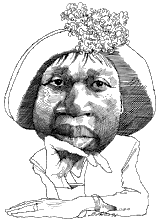
Ann Page Stecker for Katharine Black

Blogger katharine c black said...

Dear Autobiography Class,

Thank you for your interest and particularly for your generosity in class yesterday. Your questions were apt and interesting, and Dear Autobiography Class Members—
engaging for me to answer and continue to think about.

I did think of an additional comment to one question someone asked about process, about the way I learned to write dialogue, or some other "how to" question. In fact, I wrote letters for years and years, not just thank-you notes, and formal notes, but conversations to a willing reader, whom i called Letter Reader. I wrote out theories, conversations, and responses and reactions to the hate letters. I actually didn't know for years whether the Reader, read my letters, because there was never any overt response. Occasionally there would be some form of "check-in" but that regular, daily, self-analysis and checking out puzzles and problems in writing turned out to be the writing practice I'd not had in more formal settings. I articulated my responses and feelings in those letters, as though in a journal, but less self-consciously since i wrote them and sent them off immediately, and then they were gone. However, because there really was an active reader, I did work on increasing clarity and sharpness of presentation. Since it was in the format of letters, it turned out that I had been practicing dialogue all that time, and it turned out I was comfortable writing both narrative as well as conversations.

I'd thought that there was a day on which I began to write the pieces you all saw chunks of, but then it occurred to me that I'd been writing regularly for years. What was different for me, was choosing to write something I wanted to be read by others. I had actually already begun to build the tools by which to do that in regular, almost daily, writing of some kind.

I wish you each and all every success and joy in the projects and directions you choose. Thank you for your hospitality yesterday.

Peace to you each,

Katharine

A Reader in the Class

While reading, one moment struck me as odd, and that was a passage where Kazin talks about what God means to him.

"Yet it puzzled me that no one around me seemed to take God very seriously. We neither believed nor disbelieved. He was our oldest habit. For me, He was horribly the invisible head above the Board of Superintendents, the Almighty Judge Who watched you in every though and deed, and to Whom I prayed for help in passing midterms and finals, His prophetess Deborah leading me safely through so long as I remembered to say under my breath as I walked in the street, 'Desolate were the open towns in Israel, they were desolate, until that I arose, Deborah.' He filled my world with unceasing dread; He had such power over me, watched me so unrelentingly, that it puzzled me to think He had to watch all the others with the same care; one night I dreamed of Him as a great engineer in some glass-walled control tower high in the sky glaring fixedly at a brake on which my name alone was written. In some ways He was simply a mad tyrant, someone I needed constantly to propitiate. Deborah alone would know how to intercede for me. Then He became a good-luck piece I carried around to get me the things I needed. I resented this God of Israel and of the Board of Superintendents; He would never let me rest."
A Walker in the City p. 46-7


This (long) passage to me speaks to what God might mean to a lot of children raised in a religion tend to view God as someone who has been introduced so strongly that they don't really know any other way to view Him. I would also like to compare this quote to a passage in another autobiography by James Joyce called "A Portrait of the Artist as a Young Man" in which he refers to himself as "he" rather than "I" and under the name Stephen Dedalus. The quote goes:

"It was very big to think about everything and everywhere. Only God could do that. He tried to think what a big thought that must be but he could think only of God. God was God’s name just as his name was Stephen. Dieu was the French for God and that was God’s name too; and when anyone prayed to God and said Dieu then God knew at once that it was a French person that was praying. But though there were different names for God in all the different languages in the world and God understood what all the people who prayed said in their different languages still God remained always the same God and God’s real name was God."
A Portrait of the Artist as a Young Man p. 28

I found the two quotes similar, and am interested if anyone else can see this strange comparison. What's interesting is that Kazin is writing as a Jew, and Joyce as a Catholic. Any thoughts?

APS for Jenna

"Object Lessons" (39)
"This was not ordinary nature loving. I was not really a nature lover anyway. I resisted walks in Hyde Park whenever I could, and I was restless when we went out at school, paired off in the dreaded "crocodile", to pick up polished chestnuts or gather acorns. This was different. Not a season but a place. Not an observant affection but a thwarted possessiveness: a rare and virulent homesickness."

"A Walker in the City" (7, 12)
"Everything seems so small here now, old, mashed-in, more rundown even than I remember it, but with a heartbreaking familiarity at each door that makes me wonder if I can take in anything new, so strongly do I feel in Brownsville that I am walking in my sleep."

"So that when poor Jews left, even Negroes, as we said, found it easy to settle on the margins of Brownsville, and with the coming of spring, bands of Gypsies, who would rent empty stores, hang their rugs around them like a desert tent, and bring a dusty and faintly sinister air of carnival into our neighborhood."

Eavan Boland Transitioning to Alfred Kazin

"There is a duality to place. There is the place which existed before you and will continue after you have gone...Both of them prove to me there is the place that happened and the place that happens to you. That there are moments in work, in perception, in experience when it's hard to distangle them from each other. And that, at such times, the inward adventure can become so emeshed with the outward continuum that we live, not in one of the other, but at the intersection"
(Boland 154-155)
.

Boland writes of a duality between places that expresses the difference between the actual, external place or environment, and the place as a means of transformation, or the way a place can have an effect on you. This, of course, reminds me of my Pathway class "Betwixt and Between." Boland believes that a person actually exists at the point of intersection between the outward and inward forms of place. Obviously, this is a liminal passage in her autobiography and a particularly deep and multi-faceted point. This point also relates to the title of her text Object Lessons, which tells the reader that the writer has learned something abstract from something tangible and concrete. The "objects" can literally be external environments that are observed and taken in with the senses, and the "lessons" refer to the inward adventures, or the effects a place can have on an individual.

Kazin expresses a different type of duality in terms of place in his autobiograhy A Walker in the City.

"The old drugstore on our corner has been replaced by a second-hand furniture store; the old candy store has been replaced by a second-hand furniture store...It looks as if our old life has been turned out into the street, suddenly reminds me of the nude shamed look furniture on the street always had those terrible first winters of the depression..."
(Kazin 78).

Here, there is a place that Kazin remembers living in and the place that exists now as he observes it many years later. His memory passes judgment on the place, which still has the ability to bring him back to how he felt during the days of the depression. This type of duality exists for any person who has moved away from a place and chosen to return to that place for a visit one day. It's always intriguing to see how much a place can change over the course of the years population-wise, technologically, visually, etc., etc. I remember Meridian as a farm town with a population of about 5,000 people. There were literally no chain restaurants in the town, one elementary school, and a lot of open space with multitudes of trees. Now, Meridian is a prosperous industrial center in Idaho and thriving suburb of Boise. It's nothing like how I remember. Yet, there is still an old gas station near my house that has not changed in the least. Its branding is still identical to how it was ten years ago and it still sells the same delicious frozen yogurt. That is the string that I hold on to to relive the past when I visit Meridian, similar to how the furniture on the streets reminds Kazin of his childhood and adolescence during the Depression.

Eavan Boland and the importance of the written word

"I had no words for it, no way of structuring perception and no one to structure it for me. Yet I was beginning to understand that the marks on the page were a fraction of an inch high but reached a hundred miles deep into a country's past; it's fears, superstitions, and memories." - Pg. 92-93

This short passage from Eavan Boland's Object Lessons points to the importance of, necessity of, words as history. This is an important concept to understand in any literature course, it seems to me, and particularly in an autobiography course because words become both public and private history, political and personal record keeping, much as we saw in Edwidge Danticat's work. Words can easily be considered insignificant, for they are only "a fraction of an inch high," but the meanings they hold, the ideas that live inside the printed letters and spaces, are vitally important in remembering, recording, proving, telling.