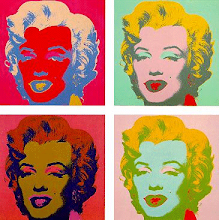
I was so fascinated by Nabokov's meditation on colors in association to the alphabet. I tried to think of colors in a different way, and I wanted to find a way to make a writing prompt about it. Thinking about some of the other writing prompts, I remember having to write about my favorite word. I was wondering if other people could think of colors, textures, or scents while thinking of their favorite word. So my writing prompt is:
Associate a color, texture, scent, sound, or number to your favorite word. Be creative! If your word is "dog" try not to associate it with a furry feel, a barking sound, or the number 3.
Wednesday, October 15, 2008

A prompt for Thursday..
When I was trying to think of a prompt for Thursday's class I tried to think of subjects that came up in all three autobiographies we have already read. The first few I thought of were relatively ordinary: education, family, childhood, lifestyle, ect. Then I thought to myself if I were to write an autobiography would I write about the joyous times in my life, or the trying times?
So my prompt for Thursday is: If you were to write your autobiography to be published for all the world to see, would you be more inclined to write about the difficult times in your life or the happy times? Why?
So my prompt for Thursday is: If you were to write your autobiography to be published for all the world to see, would you be more inclined to write about the difficult times in your life or the happy times? Why?
Periodic Sentence
I'm always fascinated with the last lines of books. I find it intriguing what last words the author wanted the audience to read as a last thought, a last moment.
There, in front of us, where a broken row of houses stood between us and the harbor, and where the eye encountered all sorts of stratagems, such as pale-blue and pink underwear cakewalking on a clothesline, or a lady's bicycle and a striped cat oddly sharing a rudimentary balcony of cast iron, it was most satisfying to make out among the jumbled angles of roofs and walls, a splendid ship's funnel, showing from behind the clothesline as something in a scrambled picture - Find What the Sailor Has Hidden - that the finder cannot unsee once it has been seen.
Even though this is all one complete sentence, what struck me was the last bit about "something in a scrambled picture... that the finder cannot unsee once it has been seen." I remember seeing a lot of "I Spy" pictures when I was younger, or those images where you stare at it enough and see an image that appears to be popping out. You would struggle to see it, and then all of a sudden it came to you, and you were so proud of yourself. The next time you looked at that picture, you'd see the image or find the object right away. It felt like you couldn't even trick yourself to work at it like you once did. I don't know about other people, but I always felt sort of lost when I knew exactly where Waldo was in all of my books. What an interesting last image for Nabokov.
There, in front of us, where a broken row of houses stood between us and the harbor, and where the eye encountered all sorts of stratagems, such as pale-blue and pink underwear cakewalking on a clothesline, or a lady's bicycle and a striped cat oddly sharing a rudimentary balcony of cast iron, it was most satisfying to make out among the jumbled angles of roofs and walls, a splendid ship's funnel, showing from behind the clothesline as something in a scrambled picture - Find What the Sailor Has Hidden - that the finder cannot unsee once it has been seen.
Even though this is all one complete sentence, what struck me was the last bit about "something in a scrambled picture... that the finder cannot unsee once it has been seen." I remember seeing a lot of "I Spy" pictures when I was younger, or those images where you stare at it enough and see an image that appears to be popping out. You would struggle to see it, and then all of a sudden it came to you, and you were so proud of yourself. The next time you looked at that picture, you'd see the image or find the object right away. It felt like you couldn't even trick yourself to work at it like you once did. I don't know about other people, but I always felt sort of lost when I knew exactly where Waldo was in all of my books. What an interesting last image for Nabokov.
Back to Nabokov's Spiral
I feel like I'm behind on posts, but I still want to share my thoughts.
We had a discussion in class about the spiral, and though my book is a bit different in pages, I want to bring up the first two sentences of Chapter 14 in "Speak, Memory"
The spiral is a spiritualized circle. In the spiral form, the circle, uncoiled, unwound, has ceased to be vicious; it has been set free.
I would like to point out that "spiritualized" is not even an official word, probably along the same lines as the term "chronophobe." With that aside, I would like to point out that in a spiritual or religious sense, circles are used as symbols of eternity. Here, Nabokov sees circles as vicious and only until it's uncoiled is it free. I always saw circles as peaceful things myself, so I tried to think of it the way Nabokov seems too. A circle is made of a line that is perfectly curved that finishes where it starts so it is continuous and you can not find the beginning or end. Then I thought, that even though a circle is eternal, it is also so finite. You can't travel beyond that line of that circle, and it just keeps looping you through the same path, just over and over and over again. A spiral, though still looping, moves you progressively forward, or back for those that see the glass half empty. Either way, there is something more than that same area, and you just keep going and going like the Energizer Bunny.
I guess circles are vicious... I know there are some events I'd rather not repeat exactly the same.
We had a discussion in class about the spiral, and though my book is a bit different in pages, I want to bring up the first two sentences of Chapter 14 in "Speak, Memory"
The spiral is a spiritualized circle. In the spiral form, the circle, uncoiled, unwound, has ceased to be vicious; it has been set free.
I would like to point out that "spiritualized" is not even an official word, probably along the same lines as the term "chronophobe." With that aside, I would like to point out that in a spiritual or religious sense, circles are used as symbols of eternity. Here, Nabokov sees circles as vicious and only until it's uncoiled is it free. I always saw circles as peaceful things myself, so I tried to think of it the way Nabokov seems too. A circle is made of a line that is perfectly curved that finishes where it starts so it is continuous and you can not find the beginning or end. Then I thought, that even though a circle is eternal, it is also so finite. You can't travel beyond that line of that circle, and it just keeps looping you through the same path, just over and over and over again. A spiral, though still looping, moves you progressively forward, or back for those that see the glass half empty. Either way, there is something more than that same area, and you just keep going and going like the Energizer Bunny.
I guess circles are vicious... I know there are some events I'd rather not repeat exactly the same.
Humor in Nabokov...YES, PLEASE.
There are quite a few passages from this autobiography that jumped off the page for me, for one reason or another.
The one I find most humorous is Nabokov's anecdote in chapter 5 about his "wicked plan." (page 103)
"I explained to my brother a wicked plan and persuaded him to accept it...my brother declared he was cold and tired, but I urged him on and finally made him ride the dog (the only member of the party to be still enjoying himself)."
This is one of the few passages where I felt like Nabokov was a relatable person, and I appreciated this. It was surprisingly humorous and almost like a "break" from the rest of the narrative, which spends a large amount of time focusing on his thoughts and specific images rather than seemingly "normal" child behavior, like this passage shows. It's something you could expect of any little boy, and because up until this point I found him, yes, I'll say it....pretentious, it was like a breath of fresh air. A point for Nabokov!
The one I find most humorous is Nabokov's anecdote in chapter 5 about his "wicked plan." (page 103)
"I explained to my brother a wicked plan and persuaded him to accept it...my brother declared he was cold and tired, but I urged him on and finally made him ride the dog (the only member of the party to be still enjoying himself)."
This is one of the few passages where I felt like Nabokov was a relatable person, and I appreciated this. It was surprisingly humorous and almost like a "break" from the rest of the narrative, which spends a large amount of time focusing on his thoughts and specific images rather than seemingly "normal" child behavior, like this passage shows. It's something you could expect of any little boy, and because up until this point I found him, yes, I'll say it....pretentious, it was like a breath of fresh air. A point for Nabokov!
Writing Prompt for Thursday, Oct. 16
Keeping with the theme of autobiography and why one would want to read another's thoughts, feelings, experiences, and memories, write about why you think you're a worthwhile person. Why should someone care to read about your life, or even get to know you in a non-literary sense? What makes you special?
Subscribe to:
Posts (Atom)