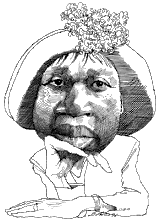
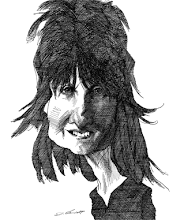
The conversation in class today with Rev. Dr. Katharine C. Black was eye opening for me, however it left me with two distinct things to think about...
First, how should one truly end an autobiography? If it is supposed to be the story of one's life, then when should someone write it? Should it be ended at a point to leave the reader thinking? Should it be ended at a point to leave the reader satisfied? I understand this is a bit rhetorical, however when Rev. Black was speaking about he "Hate Letters Narrative" she said that she may never get to finish it because the torture may never end. In my mind she should still publish what she has, however it wouldn't be a complete story without a conclusion.
Second, there was an inteserting conversation between Jackie, Ann Page, and Rev. Black about how being a well read individual makes it harder to write. Therefore, if one is to become a writer, would it be easier to write without being well read. Would one write better without being acquainted with Virginia Woolf, because to be honest, duplicating Woolf's brilliance is an adventure not worth pursuing, one would fall short. I guess the answer best came to me when Rev. Black said, "Other writers can't write my story." That is why we write for ourselves, because no one else, no matter how talented they are, can write what we have gone through. In my mind it can only benefit a writer to be well read, it will open their eyes to different styles. The only problem lies when the writer tries to "become" who they have read.
Ann Page, thank-you for bringing in Rev. Black. It was fascinating to see how much writing has changed the life of someone who is not a writer by trade. It goes to show that anyone can benefit from this form of art and that we are all better off being English Majors.
Feel free to respond because lord knows I might have completely missed the boat with this...
Thursday, November 6, 2008

Katharine C. Black
In Katharine Black's story, she references a divine spirit (or lack thereof) at the end of the chapter.
"Odd that the sanctuary light had blown out. It was always burning showing that there was consecrated host present. It was always burning. That would be nearly a first for the fastidious altar guild of the church."
Though this happens literally, I believe Black means it to be a symbolic absense of God when the character needs Him the most, as something bad is about to happen. How often do we feel like that - a need to give up our control to a higher power when we feel helpless or beyond repair? The light that's always burning is a comfort for many; it is a tangible representation of an intangible power.
"Odd that the sanctuary light had blown out. It was always burning showing that there was consecrated host present. It was always burning. That would be nearly a first for the fastidious altar guild of the church."
Though this happens literally, I believe Black means it to be a symbolic absense of God when the character needs Him the most, as something bad is about to happen. How often do we feel like that - a need to give up our control to a higher power when we feel helpless or beyond repair? The light that's always burning is a comfort for many; it is a tangible representation of an intangible power.
Katharine C. Black's "Dirty Secret"
"I thought that I should keep the letters as my dirty secret and not ever mention then. (It was several years before I told either my husband or any of my children about them.) I thought the letters would blow over. I thought they'd stop" (p. 6 of "The Beginning")
How difficult is it to keep secrets? Is secrecy a form of mental exile? What makes a person decide to keep something a secret? Do you think withholding information from a loved one is a form of deception or the right of a human being?
I wonder how hard it was for Katharine to not share this information with he husband or those who were the closest people to her heart. It seemed like she had a mental conversation with herself about letters, and she obviously spoke to her sponsor and the Bishop about the letters, but she really never got to vent her frustrations to anyone. Is that why she has chosen to share this memoir?
How difficult is it to keep secrets? Is secrecy a form of mental exile? What makes a person decide to keep something a secret? Do you think withholding information from a loved one is a form of deception or the right of a human being?
I wonder how hard it was for Katharine to not share this information with he husband or those who were the closest people to her heart. It seemed like she had a mental conversation with herself about letters, and she obviously spoke to her sponsor and the Bishop about the letters, but she really never got to vent her frustrations to anyone. Is that why she has chosen to share this memoir?
"The Box"- Katharine C. Black's Place for Memories
Rev. Dr. Katharine C. Black's first entry in our packet details reasons for saving things, more specifically saving information and items that will help a person plan and prepare for a big event. In Katharine's case, this event was her ordination (def: to officially be made a priest by a church). Katharine proposes that an individual obtain two boxes, one for documents and another for small pieces of notation on topics such as possible clothing, hymns, dates, invitation information, etc. that may relate to her ordination.
Katharine also proposes gathering ideas from other individuals' ordinations. She tells her readers that they should observe what people wear, how they answer their GOE (General Ordination Exam) questions, and what types of music might suit her future sermons.
So, as Katharine states, "What will you want to keep track of? What will you collect?" What types of "things" do you hang on to? Are there items that you have kept to help you prepare for a future event?
I really think that Katharine's proposal of keeping boxes is a reminder of Edwidge Danticat's uncle in Brother, I'm Dying. He was constantly taking note of events that occurred around him, even the most gruesome deaths and the trauma that he went through in Krome. Uncle Joseph was an avid notetaker and was clearly preparing to write his own memoirs. What types of items and notes do you think Danticat would have kept in her boxes? What about Eavan Boland?
Katharine also proposes gathering ideas from other individuals' ordinations. She tells her readers that they should observe what people wear, how they answer their GOE (General Ordination Exam) questions, and what types of music might suit her future sermons.
So, as Katharine states, "What will you want to keep track of? What will you collect?" What types of "things" do you hang on to? Are there items that you have kept to help you prepare for a future event?
I really think that Katharine's proposal of keeping boxes is a reminder of Edwidge Danticat's uncle in Brother, I'm Dying. He was constantly taking note of events that occurred around him, even the most gruesome deaths and the trauma that he went through in Krome. Uncle Joseph was an avid notetaker and was clearly preparing to write his own memoirs. What types of items and notes do you think Danticat would have kept in her boxes? What about Eavan Boland?
Descriptive words in Dr. Katharine C. Black
From the packet of works one certain aspect of Dr. Black's writing that stood out to me was her use of descriptive words or phrases. Some of the greatest examples are...
"I had the feeling at first og going out to my parked car and not finding it where I knew I have parked it and looking and looking in the same place." "Beginning"
"Grey, grizzled skies and leaking, soaking rain greeted her on this somber day..." Chapter 15 p.1
"Boats, patriotic colors promising Memorial Day eventually, summer reading books, rings for June weddings, and all the other sings of the season to come looked bright and cheerful." p.8
"I had the feeling at first og going out to my parked car and not finding it where I knew I have parked it and looking and looking in the same place." "Beginning"
"Grey, grizzled skies and leaking, soaking rain greeted her on this somber day..." Chapter 15 p.1
"Boats, patriotic colors promising Memorial Day eventually, summer reading books, rings for June weddings, and all the other sings of the season to come looked bright and cheerful." p.8
Subscribe to:
Posts (Atom)