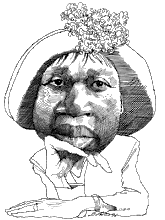
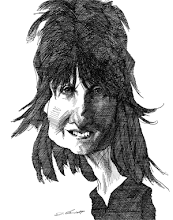
In January 1980, Mary McCarthy in a television interview with Dick Cavett was asked for an example of an "over-praised" writer. She named Lillian Hellman, stating "who I think is terribly overrated, a bad writer and a dishonoest writer." When Cavett asked what she meant by "dishonoest," McCarthy responded, "everything ..... every word she writes is a lie including 'and' and 'the."
Subsequently, Hellman sued for libel in a $2.25 million lawsuit, later dropped at the time of Hellman's death in 1984. McCarthy apparently felt put out, stating: "I still feel disgusted by the amount of lying that didn't stop. I wanted it to go to trial, so I was disappointed when she died."
Tuesday, September 30, 2008

Catholic Thoughts
"An aggressive churchgoer, she was quite without Christian feeling; the mercy of the Lord Jesus had never entered her heart. Her piety was an act of war against the Protestant ascendancy..."
I think that this is an example of something common among religious zealots today. I have always found it ironic that many influential religious leaders are the ones preaching intolerance; intolerance against certain groups of people, either of a different denomination or sexuality, for example.
As a practising Catholic, I find it a waste and a shame for someone to use their religion as a means of emanating superiority or a source of leverage. During this day and age, we are all exposed to the discrimination that can be found between different religious groups, and also the harshness of some who claim to be "serving the Lord." What ever happened to WWJD? Spread love!
I think that this is an example of something common among religious zealots today. I have always found it ironic that many influential religious leaders are the ones preaching intolerance; intolerance against certain groups of people, either of a different denomination or sexuality, for example.
As a practising Catholic, I find it a waste and a shame for someone to use their religion as a means of emanating superiority or a source of leverage. During this day and age, we are all exposed to the discrimination that can be found between different religious groups, and also the harshness of some who claim to be "serving the Lord." What ever happened to WWJD? Spread love!
Monday, September 29, 2008
Memories of a Catholic Girlhood
"Luckily, I am writing a memoir and not a work of fiction, and therefore I do not have to account for my grandmother's unpleasing character and look for the Oedipal fixation or the traumatic experience which would give her that clinical authenticity that is nowadays so desirable in portraiture. I do not know how my grandmother got the way she was; I assume, from family photographs and from the inflexibility of her habits, that she was always the same, and it seems as idle to inquire into her childhood as to ask what was ailing Iago or look for the error in toilet-training that was responsible for Lady Macbeth."
(Page 33)
(Page 33)
 "Many a time, in the course of doing these memoirs, I have wished that I were writing fiction." (Mary McCarthy, 3)
Memories of a Catholic Girlhood: Losing Faith
"These priests, I thought bitterly, seemed to imagine that you could do nothing for yourself, that everything was from inheritance and reading, just as they imagined that Christ could not have been a "mere man," and just for that matter, as they kept saying that you must have "faith," a word that had become more and more irritating to me during the past few days..."
(Page 123)
I think that many people go through a time in their life when the word "faith" means less to them than a stranger passing by on the street. Mary is clearly becoming irritated with the idea of faith because the Church and Catholic doctrine has defined what faith should be. She doesn't want to be told how to think, and that is clear in many other instances in the memoir. Her distaste of the word "faith" reminds me of a time when a friend of mine told me that she is "half-Jewish and half-Catholic." To me this seemed strange, and for some reason it has irritated me until this day. I told her that a person's religion cannot be mixed like nationalities can be. You can't be half-Jewish and half-Catholic, because you would be a complete hypocrite. You can't believe that Jesus is the Messiah one day and completely throw that belief out the window the next day. She did not understand me and just shook off what I had said, reminding me that she received double the presents during the holiday season. And then people wonder why religion is so often associated with hypocrisy!
Have you ever experienced a loss of faith? Did you regain this faith in something or someone, or did you lose it forever?
~Megan
(Page 123)
I think that many people go through a time in their life when the word "faith" means less to them than a stranger passing by on the street. Mary is clearly becoming irritated with the idea of faith because the Church and Catholic doctrine has defined what faith should be. She doesn't want to be told how to think, and that is clear in many other instances in the memoir. Her distaste of the word "faith" reminds me of a time when a friend of mine told me that she is "half-Jewish and half-Catholic." To me this seemed strange, and for some reason it has irritated me until this day. I told her that a person's religion cannot be mixed like nationalities can be. You can't be half-Jewish and half-Catholic, because you would be a complete hypocrite. You can't believe that Jesus is the Messiah one day and completely throw that belief out the window the next day. She did not understand me and just shook off what I had said, reminding me that she received double the presents during the holiday season. And then people wonder why religion is so often associated with hypocrisy!
Have you ever experienced a loss of faith? Did you regain this faith in something or someone, or did you lose it forever?
~Megan
Chiasmus
Sorry for the delay of my post, but I want to share a quote I found that to me is an example of chiasmus:
"[Captain Auld] was a slaveholder without the ability to hold slaves." In my copy it's on page 50, but it can be found in Chapter 9.
This quote stuck out to me as I was reading it because it just seemed so odd at first. It's hard for me to think, with all that I have learned about slavery, that there was a slaveholder who was not "born" for the part. I think that the idea of having someone who owned slaves but had really no idea how to do so is absurd to me. After seeing this quote, I thought more about it and realized that it wasn't such an odd idea after all. No one is born into being a certain way, but it is a matter of developing into such behaviors. Unless someone is born into wealth, they don't always hold the personality of someone who is rich when money comes into possession. It's like Douglass explains, Captain Auld was not born into a family that had slaves. This way, it's easier to understand how he did not seem to have the ability to "hold slaves."
"[Captain Auld] was a slaveholder without the ability to hold slaves." In my copy it's on page 50, but it can be found in Chapter 9.
This quote stuck out to me as I was reading it because it just seemed so odd at first. It's hard for me to think, with all that I have learned about slavery, that there was a slaveholder who was not "born" for the part. I think that the idea of having someone who owned slaves but had really no idea how to do so is absurd to me. After seeing this quote, I thought more about it and realized that it wasn't such an odd idea after all. No one is born into being a certain way, but it is a matter of developing into such behaviors. Unless someone is born into wealth, they don't always hold the personality of someone who is rich when money comes into possession. It's like Douglass explains, Captain Auld was not born into a family that had slaves. This way, it's easier to understand how he did not seem to have the ability to "hold slaves."
Saturday, September 27, 2008
The Appendix
"Sincerely and earnestly hoping that this little book may do something toward throwing light on the American slave system, and hastening the glad day of deliverance to the millions of my brethren in bonds, faithfully relying upon the power of truth, love and justice, for success in my humble efforts, and solemnly pledging myself anew to the sacred cause, I subscribe myself..."
(Page 163 in my edition)
I just find it extremely intriguing that Douglass utilizes the words truth, love, and justice in the final paragraph of his narrative. Truth, love, and justice were ideals that he never knew during slavery. He would have been beaten for telling the truth. He was separated from those he loved on almost every occasion, and, of course, he never knew justice. He witnessed injustices almost every day. I personally feel as if Douglass believes that these three words are laws of life, laws to live by. I think that Douglass taught himself to believe in truth, love deeply, and treat others justly even though he never knew these aspects of life while growing up in servitude. I guess these three words are rhetorical in and of themselves, because Douglass escaped the bonds of slavery, and only then was he able to believe in the powers of truth, love, and justice.
Can you think of any ideals and values that you hold now that you did not hold as a child? How did you learn to believe in these ideals? What caused a change in the way you thought about the world?
~Megan
Have a great weekend everyone!!!
(Page 163 in my edition)
I just find it extremely intriguing that Douglass utilizes the words truth, love, and justice in the final paragraph of his narrative. Truth, love, and justice were ideals that he never knew during slavery. He would have been beaten for telling the truth. He was separated from those he loved on almost every occasion, and, of course, he never knew justice. He witnessed injustices almost every day. I personally feel as if Douglass believes that these three words are laws of life, laws to live by. I think that Douglass taught himself to believe in truth, love deeply, and treat others justly even though he never knew these aspects of life while growing up in servitude. I guess these three words are rhetorical in and of themselves, because Douglass escaped the bonds of slavery, and only then was he able to believe in the powers of truth, love, and justice.
Can you think of any ideals and values that you hold now that you did not hold as a child? How did you learn to believe in these ideals? What caused a change in the way you thought about the world?
~Megan
Have a great weekend everyone!!!
Thursday, September 25, 2008
A Perspective
from bell hooks: Feminist Theory from Margin to Center: "Living as we did - on the edge - we developed a particular way of seeing reality. We looked both from the outside in and from the inside out. We focussed our attention on the center as well as the margin. We understood both."
Chiasmus: Definition and Examples
Chiasmus: Another definition with examples.
A rhetorical figure in which elements are presented in the order ABBA. It's named for the Greek letter chi (which looks like an "X"). The "X" suggests the crossing that characterizes the figure. Some examples:
This man I thought had been a Lord among wits; but, I find, he is only a wit among Lords.
[On The Beggar's Opera, a fabulously successful play written by John Gay and produced by John Rich:] It made Gay rich and Rich gay.
Ask not what your country can do for you, but what you can do for your country.
We can see the chiasmus in the last example (with "country" and "you") if we lay it out this way (in clumsy ASCII art, but I'm too lazy to work up a graphic):
Ask not what your country can do for you,
\ /
\ /
\ /
X
/ \
/ \
/ \
but what you can do for your country.
Chiasmus doesn't have to be the same words: it's often the same parts of speech in ABBA order. Here's Milton:
Silence, ye troubled Waves, and thou Deep, peace. (PL 7.216)
Notice it's imperative-vocative, vocative-imperative — or, if that's unclear, "Do something, you; you, do something."
A chiasmus can get even more complicated: not only ABBA, but ABCCBA. Consider Genesis 9:6:
Whoever sheds the blood of man, by man shall his blood be shed.
Notice shed-blood-man, man-blood-shed: ABC, CBA.
A rhetorical figure in which elements are presented in the order ABBA. It's named for the Greek letter chi (which looks like an "X"). The "X" suggests the crossing that characterizes the figure. Some examples:
This man I thought had been a Lord among wits; but, I find, he is only a wit among Lords.
[On The Beggar's Opera, a fabulously successful play written by John Gay and produced by John Rich:] It made Gay rich and Rich gay.
Ask not what your country can do for you, but what you can do for your country.
We can see the chiasmus in the last example (with "country" and "you") if we lay it out this way (in clumsy ASCII art, but I'm too lazy to work up a graphic):
Ask not what your country can do for you,
\ /
\ /
\ /
X
/ \
/ \
/ \
but what you can do for your country.
Chiasmus doesn't have to be the same words: it's often the same parts of speech in ABBA order. Here's Milton:
Silence, ye troubled Waves, and thou Deep, peace. (PL 7.216)
Notice it's imperative-vocative, vocative-imperative — or, if that's unclear, "Do something, you; you, do something."
A chiasmus can get even more complicated: not only ABBA, but ABCCBA. Consider Genesis 9:6:
Whoever sheds the blood of man, by man shall his blood be shed.
Notice shed-blood-man, man-blood-shed: ABC, CBA.
from Jenna Payton via APS
From Fredderick Douglass chap #10 pg #110:
"He asked me what I wanted. I told him, to let me get a new home; that as sure as I lived with Mr. Covey again, I should live with but to die with him; that Covey would surely kill me; he was in a fair way for it. Master Thomas ridiculed the idea that there was any danger of Mr. Covey; that he was a good man, and that he could not think of taking me from him; that, should he do so, he would lose the whole year's wages; that I belonged to Mr. Covey for one year, and that I must go back to him, come what might; and that I must not trouble him with any more stories, or that he would himself get hold of me."
Example of "chiasmus" because it shows Douglass' personal crossing of making a change while dealing with his enslavement. Even though Douglass is still a slave, his living and safety conditions have been questioned.
See you tomorrow!
"He asked me what I wanted. I told him, to let me get a new home; that as sure as I lived with Mr. Covey again, I should live with but to die with him; that Covey would surely kill me; he was in a fair way for it. Master Thomas ridiculed the idea that there was any danger of Mr. Covey; that he was a good man, and that he could not think of taking me from him; that, should he do so, he would lose the whole year's wages; that I belonged to Mr. Covey for one year, and that I must go back to him, come what might; and that I must not trouble him with any more stories, or that he would himself get hold of me."
Example of "chiasmus" because it shows Douglass' personal crossing of making a change while dealing with his enslavement. Even though Douglass is still a slave, his living and safety conditions have been questioned.
See you tomorrow!
from Jessica Stewart via APS
- How weather played a part in a memory that you have. Memory and weather linked? 9/16
- 9/18 Prompt: Most traumatic experience, and how it shaped you. The most traumatic experience of my life has been the death of my mother. The things that I saw and encountered were very eye-opening. This has made me take on a different perspective on life than I had before. There were a lot of things that I saw that made me realize that we are human and that we do not live forever
- 9/18 Prompt: Most traumatic experience, and how it shaped you. The most traumatic experience of my life has been the death of my mother. The things that I saw and encountered were very eye-opening. This has made me take on a different perspective on life than I had before. There were a lot of things that I saw that made me realize that we are human and that we do not live forever
Chiasmus
"He spoke but to command, and commanded but to be obeyed; he dealt sparingly with his words, and bountifully with his whip, never using the former where the latter would answer as well."
This chiasmus was on Page 66.
This chiasmus was on Page 66.
Subscribe to:
Posts (Atom)