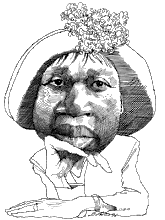
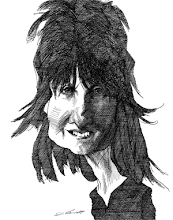
So, I received a comment on my enormous post about Eavan Boland by an actual, real-life Boland scholar, Jody Allen Randolph. Ann Page suggested that I try to contact her... but my efforts at finding contact information have failed miserably. So... suggestions?
This is a page that has some info on her (but no contact info!!): http://www.westmont.edu/_academics/departments/english/dr-jody-allenrandolph.html
I can't find her in the directory, either. If you have any luck, please let me know. Otherwise, we may just have to live with our chance, one-time encounter.
Wednesday, November 5, 2008

Tuesday, November 4, 2008
Another work by Eavan Boland that I would like to share
"Anorexic"

Flesh is heretic.
My body is a witch.
I am burning it.

Yes I am torching
ber curves and paps and wiles.
They scorch in my self denials.

How she meshed my head
in the half-truths
of her fevers

till I renounced
milk and honey
and the taste of lunch.

I vomited
her hungers.
Now the bitch is burning.

I am starved and curveless.
I am skin and bone.
She has learned her lesson.

Thin as a rib
I turn in sleep.
My dreams probe

a claustrophobia
a sensuous enclosure.
How warm it was and wide

once by a warm drum,
once by the song of his breath
and in his sleeping side.

Only a little more,
only a few more days
sinless, foodless,

I will slip
back into him again
as if I had never been away.

Caged so
I will grow
angular and holy

past pain,
keeping his heart
such company

as will make me forget
in a small space
the fall

into forked dark,
into python needs
heaving to hips and breasts
and lips and heat
and sweat and fat and greed.


In class we talked about how many poems written by Boland were often criticized, or
at least noted, to be written almost autobiographically.  My point was because of
our preconceived notion of writing about "what we know" that we are more likely to
assume that any poetry or prose is written with at least some truth to the author.
Though Anorexia is a very real and serious condition, I do not believe that Boland
was one of the women who has struggled or is struggling with this disorder.  The
imagery in this poem is striking, and though partially disturbing I think would
benefit readers.  We get a better sense of how Eavan Boland uses her creative mind to
fill in what she does not know.  This idea is also presented in Object Lessons as she
tries to piece together what information she has of her grandmother while at the same
time creating details of which she has no proof... such as the red hat.
Simplicity in Boland
"I wanted simplicity. I craved it. At school I would learn Thomas Hood's poem: 'I remember, I remember/The house where I was born.' But as time went on, I didn't. Such memory as I had was constantly being confused and disrupted by gossip and homily, by the brisk and contingent talk of adults. 'Stop that. Settle down. Go to sleep now.'" ~Object Lessons, p. 38
What I like about this passage is that as Boland talks of simplicity and her desire for it, she manages to keep her sentences from their usual complexities. She is speaking of her childhood at this time, and so the quick and short sentences are fitting to the situation. Where the one sentence expands itself, it is for the purpose (as I see it) of accentuating that her memories of childhood were "being confused and disrupted" by those around her.
Two Quick Side Notes:
-I don't remember the house where I was born because we moved months afterwards.
-Ann Page, I'm sure you were pleased to see "contingent" used in this passage
What I like about this passage is that as Boland talks of simplicity and her desire for it, she manages to keep her sentences from their usual complexities. She is speaking of her childhood at this time, and so the quick and short sentences are fitting to the situation. Where the one sentence expands itself, it is for the purpose (as I see it) of accentuating that her memories of childhood were "being confused and disrupted" by those around her.
Two Quick Side Notes:
-I don't remember the house where I was born because we moved months afterwards.
-Ann Page, I'm sure you were pleased to see "contingent" used in this passage
APS for Jenna
Eavan Boland
page #24 "Poetry"
"The mystique was sustained by prescriptions. Poetry, it was suggested, was something of power and resonance. It was also a good deal removed from that life which was deemed ordinary."
page #24 "Poetry"
"The mystique was sustained by prescriptions. Poetry, it was suggested, was something of power and resonance. It was also a good deal removed from that life which was deemed ordinary."
Language & Exile
It seems as though this year I have become incredibly interested in how language is used in text. Boland discusses language, and its incredible importance, on nearly every page. I have also noticed the link between Danticat and Boland in their feelings of isolation, or more specifically, exile. The following passage discusses both the exile, and the use of language...
"The inevitable happened. One day my tongue betrayed me out of dream and counterfeit into cold truth. I was in the cloakroom at school in the middle of the afternoon. A winter darkness was already gathering through one of the stubborn fogs of the time. A teacher was marshaling children here and there, dividing those who were taking buses from those who were being collected. "I amn't taking the bust," I said. I was six or seven then, still within earshot of another way of speaking. But the English do not use that particular construction. It was an older usage. If they contract the verb and the negative they say, "I'm not." Boland p. 46
"The inevitable happened. One day my tongue betrayed me out of dream and counterfeit into cold truth. I was in the cloakroom at school in the middle of the afternoon. A winter darkness was already gathering through one of the stubborn fogs of the time. A teacher was marshaling children here and there, dividing those who were taking buses from those who were being collected. "I amn't taking the bust," I said. I was six or seven then, still within earshot of another way of speaking. But the English do not use that particular construction. It was an older usage. If they contract the verb and the negative they say, "I'm not." Boland p. 46
More Splice-en-dipity in Danticat's "Auto"Biography
I apologize for completely forgetting to post this over the weekend. Here is my entry on Danticat's ability to splice stories into her autobiography, a technique that actually seems to remove Edwidge from the horrors of her own story.
One story that I think of off the top of my head is the folk tale that Edwidge shares with her readers in the final pages of her book. After Edwidge's father dies, one of Granme Melina's stories is included to serve as a parallel to what is going on in Edwidge's life. The story ends with the following passages:
"...The daughter took the false teeth in her hands and looked at them with great sadness, but also with a new sense of courage. 'As my father wishes, so it shall be,' she said. "We will have the wake to honor him, to rejoice and celebrate his life before his body is put in the ground. We will eat. We will sing. We will dance and tell stories. But most importantly, we will speak of my father. For it is not our way to let our grief silence us" (pg. 267).
This brief story allows readers to know exactly how Edwidge dealt with her father's death (and also her uncle's, I'm sure). Of course she wanted her father back at first. Of course she wanted to raise him from the dead. Grief is sometimes handled with this form of denial and not being able to recognize that the dead individual is gone forever. However, Edwidge eventually came to terms with her father's death and accepted what had occured. She decided that it was more important to honor her father by remembering him through stories, rather than remaining in a state of complete mourning.
The final portion of the passage actually reminds me of the character I am playing in "SNAFU: Unplugged." Jaimee is considered "the one who talks" in order to deal with her father's death. She loves to tell stories about him in order to remember. When I read the passage, especially the line about not allowing grief to silence you, I could not help but think of Jaimee!
One story that I think of off the top of my head is the folk tale that Edwidge shares with her readers in the final pages of her book. After Edwidge's father dies, one of Granme Melina's stories is included to serve as a parallel to what is going on in Edwidge's life. The story ends with the following passages:
"...The daughter took the false teeth in her hands and looked at them with great sadness, but also with a new sense of courage. 'As my father wishes, so it shall be,' she said. "We will have the wake to honor him, to rejoice and celebrate his life before his body is put in the ground. We will eat. We will sing. We will dance and tell stories. But most importantly, we will speak of my father. For it is not our way to let our grief silence us" (pg. 267).
This brief story allows readers to know exactly how Edwidge dealt with her father's death (and also her uncle's, I'm sure). Of course she wanted her father back at first. Of course she wanted to raise him from the dead. Grief is sometimes handled with this form of denial and not being able to recognize that the dead individual is gone forever. However, Edwidge eventually came to terms with her father's death and accepted what had occured. She decided that it was more important to honor her father by remembering him through stories, rather than remaining in a state of complete mourning.
The final portion of the passage actually reminds me of the character I am playing in "SNAFU: Unplugged." Jaimee is considered "the one who talks" in order to deal with her father's death. She loves to tell stories about him in order to remember. When I read the passage, especially the line about not allowing grief to silence you, I could not help but think of Jaimee!
The Autobiography of the English Major About to Graduate
...as told through the musical stylings of Jamie Cullum.
Monday, November 3, 2008
Because I bought -- AND READ -- the wrong book...
So, I bought the wrong book... mine was Object Lessons by Anna Quindlen. It's really good; I'd recommend it. Unfortunately, it is not the book we were assigned... So, because there is no way I can get a copy of the book and read it by tomorrow, I've been allowed instead to take a look at some of Eavan Boland's poetry... so here goes. I do hope you enjoy what follows.
The Pomegranate
by Eavan Boland
The only legend I have ever loved is
the story of a daughter lost in hell.
And found and rescued there.
Love and blackmail are the gist of it.
Ceres and Persephone the names.
And the best thing about the legend is
I can enter it anywhere. And have.
As a child in exile in
a city of fogs and strange consonants,
I read it first and at first I was
an exiled child in the crackling dusk of
the underworld, the stars blighted. Later
I walked out in a summer twilight
searching for my daughter at bed-time.
When she came running I was ready
to make any bargain to keep her.
I carried her back past whitebeams
and wasps and honey-scented buddleias.
But I was Ceres then and I knew
winter was in store for every leaf
on every tree on that road.
Was inescapable for each one we passed.
And for me.
It is winter
and the stars are hidden.
I climb the stairs and stand where I can see
my child asleep beside her teen magazines,
her can of Coke, her plate of uncut fruit.
The pomegranate! How did I forget it?
She could have come home and been safe
and ended the story and all
our heart-broken searching but she reached
out a hand and plucked a pomegranate.
She put out her hand and pulled down
the French sound for apple and
the noise of stone and the proof
that even in the place of death,
at the heart of legend, in the midst
of rocks full of unshed tears
ready to be diamonds by the time
the story was told, a child can be
hungry. I could warn her. There is still a chance.
The rain is cold. The road is flint-coloured.
The suburb has cars and cable television.
The veiled stars are above ground.
It is another world. But what else
can a mother give her daughter but such
beautiful rifts in time?
If I defer the grief I will diminish the gift.
The legend will be hers as well as mine.
She will enter it. As I have.
She will wake up. She will hold
the papery flushed skin in her hand.
And to her lips. I will say nothing.
Clearly, this poem references the myth of Persephone, who is abducted by ... I thought it was Hades, but apparently not ... Ceres and taken to the underworld to live with him FOREVER. But, Persephone's mom, Demeter (goddess of the seasons!!), is not okay with this situation. She cancels all the good seasons of the year and makes it winter all the time, insisting that she will only bring back warmth and plant life and so forth if Persephone is returned to her... I forget some details, but the upshot is that Hades says Persephone can go back, but silly Persephone eats a pomegranate while she's in the Underworld, so she is doomed to have to return for half the year, every year. Hence the seasons.
So, Boland is discussing her relationship to this myth and how it has played a role in her life at various points. First, she tells us about her own childhood, when she imagined that the city she didn't like was really the Underworld, thus making herself Persephone.
Then, Boland tells us of a time when she was afraid her daughter was missing and felt the despair that Demeter must have felt. In this instance, her role becomes more that of Demeter, although she states that she has become Ceres. This is, perhaps, because she wants to take her daughter back with her and keep her, so as not to risk losing her again... so by removing her daughter from the world she is sort of Demeter and Ceres at once.
Boland then moves on to discuss the role of the pomegranate in the myth, and how it is the key to Persephone's ultimate fate. Boland says she could warn her daughter about the pomegranate, that she should not eat it, but she understands the hunger which Persephone must have felt, and she decides that it is best to let her daughter make her own mistakes, or so it seems to me.
So, I think that both the myth and this poem, in some ways, are stories of losing innocence. Perhaps the pomegranate symbolizes this most clearly, much the same way as the apple symbolizes falling from grace in the story of Adam and Eve (which I'm sure I don't need to outline for you...). Boland gives us three examples of losing some sort of innocence or falling from grace: her own, as a child, discovering the wide city around her is really a cage, a trap, a prison for her to live out her exile; her second loss of grace when she becomes a jealous figure bent on keeping her daughter to herself; and a third instance, of her daughter's eventual, future loss of innocence when she succumbs to some sort of temptation which binds her to a mortal life (or perhaps just binds her to a "normal" life that is within the bounds of "ordinary" rather than "extraordinary").
Aaaaand, number two:
Atlantis—A Lost Sonnet
by Eavan Boland
How on earth did it happen, I used to wonder
that a whole city—arches, pillars, colonnades,
not to mention vehicles and animals—had all
one fine day gone under?
I mean, I said to myself, the world was small then.
Surely a great city must have been missed?
I miss our old city —
white pepper, white pudding, you and I meeting
under fanlights and low skies to go home in it. Maybe
what really happened is
this: the old fable-makers searched hard for a word
to convey that what is gone is gone forever and
never found it. And so, in the best traditions of
where we come from, they gave their sorrow a name
and drowned it.
So, I felt drawn to this poem in part because the myth of Atlantis has stymied (really?) me for as long as I recall knowing it. I too have wondered how the heck a city could disappear without a trace.
Clearly, there is more to this poem than just a contemplation of a missing, ancient, perhaps made-up city. Boland relates Atlantis to a general sense of loss, both her own sense of losing a particular city and a less particular sense of loss in general. Boland suggests that perhaps the story of Atlantis is not based in any reality of a lost city of the ancient world, but perhaps that Atlantis just served as a symbol of loss to those who created it. Isn't that sort of what all myths are about? Not loss in particular, but aren't all myths symbols for something more?
Does anyone else notice that both of these poems revolve around ancient myths?? Tricky. Perhaps Boland is pointing to the fact that ancient myths serve a very real purpose even in the modern world; they provide answers, allegorical models, explanations, excuses, and perhaps even plots for our very own lives.
The Pomegranate
by Eavan Boland
The only legend I have ever loved is
the story of a daughter lost in hell.
And found and rescued there.
Love and blackmail are the gist of it.
Ceres and Persephone the names.
And the best thing about the legend is
I can enter it anywhere. And have.
As a child in exile in
a city of fogs and strange consonants,
I read it first and at first I was
an exiled child in the crackling dusk of
the underworld, the stars blighted. Later
I walked out in a summer twilight
searching for my daughter at bed-time.
When she came running I was ready
to make any bargain to keep her.
I carried her back past whitebeams
and wasps and honey-scented buddleias.
But I was Ceres then and I knew
winter was in store for every leaf
on every tree on that road.
Was inescapable for each one we passed.
And for me.
It is winter
and the stars are hidden.
I climb the stairs and stand where I can see
my child asleep beside her teen magazines,
her can of Coke, her plate of uncut fruit.
The pomegranate! How did I forget it?
She could have come home and been safe
and ended the story and all
our heart-broken searching but she reached
out a hand and plucked a pomegranate.
She put out her hand and pulled down
the French sound for apple and
the noise of stone and the proof
that even in the place of death,
at the heart of legend, in the midst
of rocks full of unshed tears
ready to be diamonds by the time
the story was told, a child can be
hungry. I could warn her. There is still a chance.
The rain is cold. The road is flint-coloured.
The suburb has cars and cable television.
The veiled stars are above ground.
It is another world. But what else
can a mother give her daughter but such
beautiful rifts in time?
If I defer the grief I will diminish the gift.
The legend will be hers as well as mine.
She will enter it. As I have.
She will wake up. She will hold
the papery flushed skin in her hand.
And to her lips. I will say nothing.
Clearly, this poem references the myth of Persephone, who is abducted by ... I thought it was Hades, but apparently not ... Ceres and taken to the underworld to live with him FOREVER. But, Persephone's mom, Demeter (goddess of the seasons!!), is not okay with this situation. She cancels all the good seasons of the year and makes it winter all the time, insisting that she will only bring back warmth and plant life and so forth if Persephone is returned to her... I forget some details, but the upshot is that Hades says Persephone can go back, but silly Persephone eats a pomegranate while she's in the Underworld, so she is doomed to have to return for half the year, every year. Hence the seasons.
So, Boland is discussing her relationship to this myth and how it has played a role in her life at various points. First, she tells us about her own childhood, when she imagined that the city she didn't like was really the Underworld, thus making herself Persephone.
Then, Boland tells us of a time when she was afraid her daughter was missing and felt the despair that Demeter must have felt. In this instance, her role becomes more that of Demeter, although she states that she has become Ceres. This is, perhaps, because she wants to take her daughter back with her and keep her, so as not to risk losing her again... so by removing her daughter from the world she is sort of Demeter and Ceres at once.
Boland then moves on to discuss the role of the pomegranate in the myth, and how it is the key to Persephone's ultimate fate. Boland says she could warn her daughter about the pomegranate, that she should not eat it, but she understands the hunger which Persephone must have felt, and she decides that it is best to let her daughter make her own mistakes, or so it seems to me.
So, I think that both the myth and this poem, in some ways, are stories of losing innocence. Perhaps the pomegranate symbolizes this most clearly, much the same way as the apple symbolizes falling from grace in the story of Adam and Eve (which I'm sure I don't need to outline for you...). Boland gives us three examples of losing some sort of innocence or falling from grace: her own, as a child, discovering the wide city around her is really a cage, a trap, a prison for her to live out her exile; her second loss of grace when she becomes a jealous figure bent on keeping her daughter to herself; and a third instance, of her daughter's eventual, future loss of innocence when she succumbs to some sort of temptation which binds her to a mortal life (or perhaps just binds her to a "normal" life that is within the bounds of "ordinary" rather than "extraordinary").
Aaaaand, number two:
Atlantis—A Lost Sonnet
by Eavan Boland
How on earth did it happen, I used to wonder
that a whole city—arches, pillars, colonnades,
not to mention vehicles and animals—had all
one fine day gone under?
I mean, I said to myself, the world was small then.
Surely a great city must have been missed?
I miss our old city —
white pepper, white pudding, you and I meeting
under fanlights and low skies to go home in it. Maybe
what really happened is
this: the old fable-makers searched hard for a word
to convey that what is gone is gone forever and
never found it. And so, in the best traditions of
where we come from, they gave their sorrow a name
and drowned it.
So, I felt drawn to this poem in part because the myth of Atlantis has stymied (really?) me for as long as I recall knowing it. I too have wondered how the heck a city could disappear without a trace.
Clearly, there is more to this poem than just a contemplation of a missing, ancient, perhaps made-up city. Boland relates Atlantis to a general sense of loss, both her own sense of losing a particular city and a less particular sense of loss in general. Boland suggests that perhaps the story of Atlantis is not based in any reality of a lost city of the ancient world, but perhaps that Atlantis just served as a symbol of loss to those who created it. Isn't that sort of what all myths are about? Not loss in particular, but aren't all myths symbols for something more?
Does anyone else notice that both of these poems revolve around ancient myths?? Tricky. Perhaps Boland is pointing to the fact that ancient myths serve a very real purpose even in the modern world; they provide answers, allegorical models, explanations, excuses, and perhaps even plots for our very own lives.
Sunday, November 2, 2008
Object Lessons
"This is the way we make the past. This is the way I will make it here. Listening for hooves. Glimpsing the red hat which was never there in the first place. Giving eyesight and evidence to a woman we never knew and cannot now recover. And for all our violations, the past waits for us. The road from the train to the hosputal opens out over and over again, vacant and glittering, offering shadows and hats and hoops. Again and again I visit and reinvent it. But the woman who actually traveled it had no such license. Hers was a real journey. She did not come back. On October 10 she died in the National Maternity Hospital. She was thirty-one years of age. She was my grandmother."
page 5
page 5
Friday, October 31, 2008
Uncle Joseph
"My uncle did not look resigned and serene like most of the dead I have seen. Perhaps it was because his lips were swollen to twice their usual size. He looked as though he'd been punched. He also appeared anxious and shocked, as though he were having a horrible nightmare.
When was he last conscious? I wondered. What were his final thoughts? When did he realize he was dying? Was he afraid? Did he think it ironic that he would soon be the dead prisoner of the same government that had been occupying his country when he was born? In essence he was entering and exiting the world under the same flag. Never really sovereign, as his father had dreamed, never really free. What would he think of being buried here? Would he forever, proverbially, turn in his grave?"
(Page 250)
This passage really stayed with me for a few reasons. America, for many people living in different countries, really is a beacon of light or hope, or a land of fortune compared with their own misfortune and underprivileged lives. As a reader and an American, I really thought that once Uncle Joseph fled Haiti and got to America he would be safe. I feel saddened by what happened to him. Not only was he treated like a number and not a person, but he never even got a chance to see his family one last time. It's also a shame that he never wanted to leave Haiti and was finally forced to, and died in the process. I think Uncle Joseph's death was the most tragic because it was so unexpected, unjust, and happened in such an undignified way.
When was he last conscious? I wondered. What were his final thoughts? When did he realize he was dying? Was he afraid? Did he think it ironic that he would soon be the dead prisoner of the same government that had been occupying his country when he was born? In essence he was entering and exiting the world under the same flag. Never really sovereign, as his father had dreamed, never really free. What would he think of being buried here? Would he forever, proverbially, turn in his grave?"
(Page 250)
This passage really stayed with me for a few reasons. America, for many people living in different countries, really is a beacon of light or hope, or a land of fortune compared with their own misfortune and underprivileged lives. As a reader and an American, I really thought that once Uncle Joseph fled Haiti and got to America he would be safe. I feel saddened by what happened to him. Not only was he treated like a number and not a person, but he never even got a chance to see his family one last time. It's also a shame that he never wanted to leave Haiti and was finally forced to, and died in the process. I think Uncle Joseph's death was the most tragic because it was so unexpected, unjust, and happened in such an undignified way.
Thursday, October 30, 2008
Splicedness
The passage I want to bring up is sort of long, but it is pages 181-182 at the start of the chapter titled "Hell." Here, Danticat is sharing yet another story told by Granmè Melina about a man who finds himself in Hell. The story ends abruptly on page 182 with a quick transition from the last line of the story to where it moves on at "The next morning, Monday, at four a.m.," and so on.
This "splicing" of literature is a technique used by Danticat a lot which keeps her story interesting. It's an interesting way to see the story she was told as it interrupts the story she is telling, and that keeps her still distant and separate from her emotions towards the situations. Especially with a tale about Hell where it is defined as being "whatever you fear most" when the following line talks of Maxo and his family going somewhere reluctantly.
This "splicing" of literature is a technique used by Danticat a lot which keeps her story interesting. It's an interesting way to see the story she was told as it interrupts the story she is telling, and that keeps her still distant and separate from her emotions towards the situations. Especially with a tale about Hell where it is defined as being "whatever you fear most" when the following line talks of Maxo and his family going somewhere reluctantly.
where is edwidge?
"Beating the Darkness"
this chapter features a narrative on the events of the october 24, 2004 when United Nations soldiers and local riot police joined forces in trying to eradicate the murderous gangs from Bel Air. the thing that struck me about this particle passage, is that edwidge is nowhere in the events that took place. and yet, her retelling of what happened is intriguingly detailed and clear.
---------
i think perhaps the most gripping line from that whole section, is on page 171. it reads: "Looking over the trashstrewn alleys that framed the building, he thought for the first time since he'd lost Tante Denise that he was glad she was dead." for me, that is so heavy. what a thought for her uncle to be having. in my opinion, a thought like that is so personal, that it can only come out of some kind of deep love, nurtured and cultivated over a great time. i feel like, to be thankful for someones absence in life, can only be created from an incredible sense of hopelessness. and this is what's going on within the mind and emotions of danticats uncle, though she's writing it.
i want to know how she knew that was what he was thinking, because of how outside of herself a moment like that is.
did he admit this extremely personal moment to edwidge? or is this part of the imagination that comes with the creative license given to all writers?
this chapter features a narrative on the events of the october 24, 2004 when United Nations soldiers and local riot police joined forces in trying to eradicate the murderous gangs from Bel Air. the thing that struck me about this particle passage, is that edwidge is nowhere in the events that took place. and yet, her retelling of what happened is intriguingly detailed and clear.
---------
i think perhaps the most gripping line from that whole section, is on page 171. it reads: "Looking over the trashstrewn alleys that framed the building, he thought for the first time since he'd lost Tante Denise that he was glad she was dead." for me, that is so heavy. what a thought for her uncle to be having. in my opinion, a thought like that is so personal, that it can only come out of some kind of deep love, nurtured and cultivated over a great time. i feel like, to be thankful for someones absence in life, can only be created from an incredible sense of hopelessness. and this is what's going on within the mind and emotions of danticats uncle, though she's writing it.
i want to know how she knew that was what he was thinking, because of how outside of herself a moment like that is.
did he admit this extremely personal moment to edwidge? or is this part of the imagination that comes with the creative license given to all writers?
Subscribe to:
Posts (Atom)